September 2026 EB-5 Visa Bulletin: Reserved Categories Remain Current as Unreserved Visa Demand Grows

The September 2026 Visa Bulletin brings an important message for EB-5 investors as the U.S. government approaches the end of Fiscal Year 2026.
While the traditional Unreserved EB-5 category continues to experience significant demand, particularly among investors from India and China, the three EB-5 Reserved Visa Categories remain Current for investors from all countries.
For prospective investors, this distinction is becoming increasingly important.
The September Visa Bulletin demonstrates that EB-5 visa availability is no longer simply a question of whether an investor qualifies for the program. Investors should also understand which EB-5 visa category their investment falls under, how visa demand may affect their immigration timeline, and how the selection of an EB-5 project can influence their overall immigration strategy.
The September 2026 EB-5 Visa Bulletin at a Glance
Under the EB-5 Reform and Integrity Act of 2022, EB-5 visas are divided into two broad groups:
Unreserved EB-5: 68% of EB-5 visas
Reserved EB-5: 32% of EB-5 visas
The reserved allocation is further divided into:
Rural Area: 20%
High-Unemployment Area: 10%
Infrastructure: 2%
For September 2026, the Department of State lists all three Reserved categories as Current for all chargeability areas, including China and India.
September 2026 EB-5 Final Action Dates
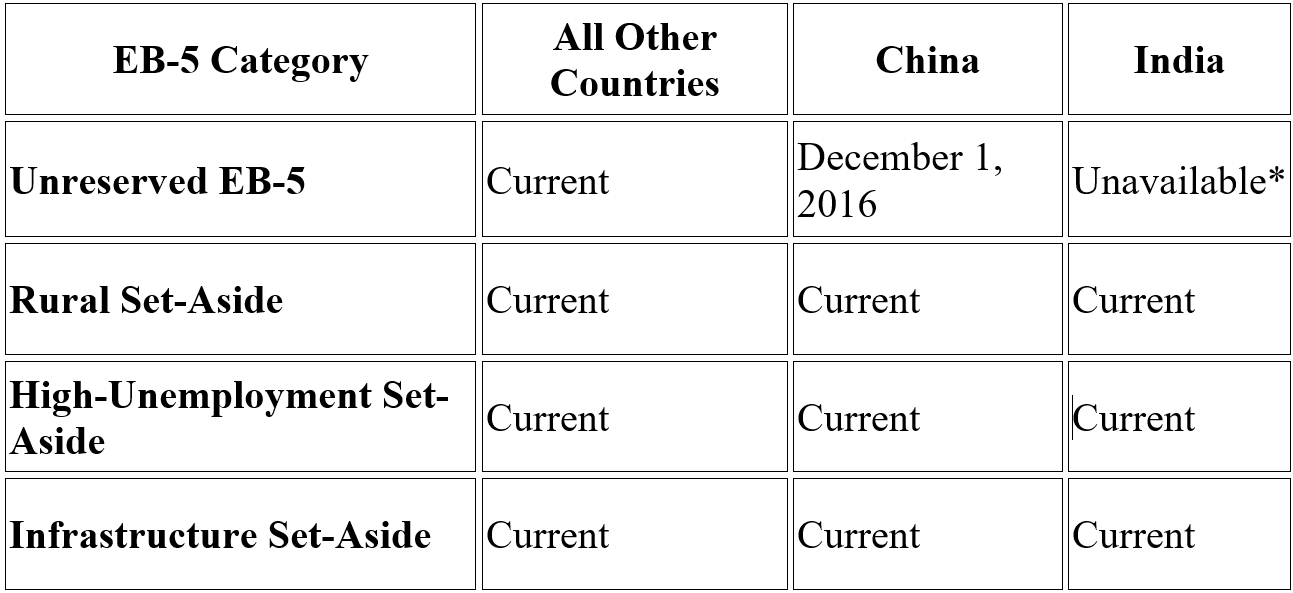
*India's FY 2026 EB-5 Unreserved visa allocation was reached earlier in the fiscal year. The Department of State confirmed that all available EB-5 Unreserved visas for India had been issued as of June 5, 2026. Visa issuance in that category can resume when the new fiscal year begins on October 1, 2026.
The Good News: EB-5 Reserved Categories Remain Current
The most encouraging development in the September 2026 Visa Bulletin is the continued availability of the three EB-5 Reserved Visa Categories.
For investors from countries experiencing significant EB-5 demand, including China and India, the fact that these categories remain Current is particularly noteworthy.
A Current designation means that the Visa Bulletin does not establish a cut-off date for that category. However, investors must still satisfy all applicable EB-5 and immigration requirements before receiving permanent resident status.
The continued availability of Reserved EB-5 visas highlights the potential importance of understanding the category associated with a particular investment.
Rural EB-5
The Rural Area set-aside reserves 20% of annual EB-5 visas for qualifying investments in designated rural areas.
Rural projects can be particularly attractive to investors because the category currently remains Current across all countries. In addition, qualifying rural EB-5 petitions may receive priority processing under the EB-5 Reform and Integrity Act.
However, investors should not choose a project simply because it qualifies as rural.
The underlying investment still requires careful due diligence, including an assessment of the developer, project economics, financing structure, job creation projections, exit strategy, and immigration compliance.
High-Unemployment Area EB-5
The High-Unemployment Area category reserves 10% of annual EB-5 visas for qualifying projects located in areas that meet the program's requirements.
This category also remains Current for all countries in September 2026.
For investors considering projects in different geographic locations, understanding whether a project qualifies for the High-Unemployment Area set-aside can therefore be an important part of evaluating its immigration structure.
Infrastructure EB-5
The Infrastructure category represents 2% of the annual EB-5 allocation.
Although it is the smallest of the three reserved categories, it remains Current for all countries in September 2026.
Infrastructure projects must satisfy specific statutory requirements, so investors should confirm that a project genuinely qualifies before relying on its reserved visa classification.
India: Unreserved EB-5 Visas Have Reached the FY 2026 Limit
The situation for Indian investors is one of the most significant EB-5 developments of 2026.
On June 10, 2026, the U.S. Department of State announced that India had reached its per-country limit for the EB-5 Unreserved category for Fiscal Year 2026.
According to the Department of State, all available EB-5 Unreserved immigrant visas for applicants chargeable to India had been issued as of June 5, 2026. As a result, U.S. embassies and consulates could no longer issue additional Unreserved EB-5 visas to Indian applicants during the remainder of FY 2026.
This does not mean that Indian investors are permanently excluded from the EB-5 program.
The annual limits reset on October 1, 2026, when Fiscal Year 2027 begins. At that point, visa issuance in the Unreserved category can resume for qualified applicants, subject to the applicable visa limits and demand.
For Indian investors, this makes the distinction between Unreserved and Reserved EB-5 categories especially important.
China: A Significant Unreserved EB-5 Backlog Remains
Chinese investors continue to face a different situation.
For September 2026, the Unreserved EB-5 Final Action Date for China is December 1, 2016. This means that applicants chargeable to mainland China whose priority dates are later than the listed cut-off are not currently eligible for final visa issuance in the Unreserved category.
The Dates for Filing chart provides a later date of March 1, 2017 for Chinese Unreserved EB-5 applicants. However, investors should distinguish between a filing date and a Final Action Date, as they serve different purposes in the immigration process.
The important point for investors is that China's Unreserved EB-5 category remains significantly backlogged, while the Reserved categories remain Current.
What About Indian Investors After October 1?
The beginning of Fiscal Year 2027 on October 1, 2026, will be closely watched by Indian EB-5 investors.
The reset of annual visa numbers means that the Unreserved category will no longer be unavailable solely because India's FY 2026 allocation has been exhausted.
However, this does not guarantee that the category will remain Current throughout FY 2027.
Visa availability is affected by demand, annual numerical limits, per-country limits, and the rate at which visa numbers are used.
The September bulletin itself cautions that increased demand and number use in the EB-5 Unreserved category may require the Department of State to retrogress the Final Action Date or make the category unavailable if necessary to stay within FY 2026 limits.
This is an important reminder that visa availability can change as the fiscal year progresses.
Why Reserved EB-5 Is Receiving More Attention
The current Visa Bulletin creates an important contrast:
Unreserved EB-5:
China faces a substantial backlog, while India has reached its FY 2026 allocation.Reserved EB-5:
Rural, High-Unemployment, and Infrastructure categories remain Current for all countries.
For investors evaluating an EB-5 opportunity today, understanding this difference may be just as important as understanding the investment amount and project location.
The EB-5 Reform and Integrity Act was designed in part to create dedicated visa pathways for specific types of investments. As demand in the Unreserved category increases, these set-aside categories may become increasingly relevant to investors planning their immigration strategy.
Does “Current” Mean an Investor Gets a Green Card Immediately?
No.
A Current visa category should not be interpreted as an automatic or immediate green card approval.
An EB-5 investor must still satisfy the applicable requirements, which can include:
Making the required qualifying investment;
Demonstrating the lawful source and path of investment funds;
Investing in a qualifying commercial enterprise;
Demonstrating the required job creation;
Filing the appropriate immigration petition;
Completing the required adjustment of status or consular processing; and
Meeting all other applicable immigration requirements.
Visa availability is one part of the EB-5 process, not the entire process.
Visa Availability Should Be Part of Project Due Diligence
For investors, the September 2026 Visa Bulletin reinforces an important principle:
An EB-5 project should be evaluated from both an immigration perspective and an investment perspective.
Before selecting a project, investors should consider:
Developer Track Record
Who is developing the project? What is the developer's history of completing comparable projects? Has the developer successfully delivered projects and repaid investors in previous transactions?
Job Creation
Does the project have sufficient projected job creation to provide an appropriate cushion above the required 10 jobs per investor?
Capital Structure
How much capital is being invested in the project? What other sources of financing are involved? Where does the EB-5 capital sit within the capital stack?
Project Economics
Does the project's business plan make sense based on the local market, demand, revenue assumptions, costs, financing, and development timeline?
Immigration Structure
Does the project properly qualify for its claimed EB-5 category? If the project is marketed as a Rural, High-Unemployment, or Infrastructure project, investors should understand the basis for that classification.
Exit Strategy
How and when is the EB-5 capital expected to be repaid? What factors could affect the timing or ability of the project to return investor capital?
These considerations remain important regardless of whether the applicable visa category is Current.
What Should Investors Watch in October 2026?
The October 2026 Visa Bulletin will be particularly important because it will mark the beginning of Fiscal Year 2027.
Investors will be watching to see:
How the Unreserved EB-5 category changes after the FY 2026 allocation resets;
Whether India receives renewed Unreserved visa availability;
Whether China's Unreserved cut-off date moves;
Whether Reserved EB-5 categories remain Current;
How much demand has accumulated across the EB-5 categories; and
Whether the Department of State makes any changes to Final Action or Dates for Filing cut-offs.
The October bulletin may provide a clearer picture of how EB-5 visa availability will develop during the new fiscal year.
The Bigger Picture for EB-5 Investors
The September 2026 Visa Bulletin illustrates how the EB-5 program has evolved since the introduction of the Reserved Visa Categories.
For investors from countries with significant EB-5 demand, immigration planning increasingly involves more than simply determining whether they qualify for EB-5.
Investors should understand which visa category their investment falls into, whether that category is subject to a backlog, and how future demand could affect their immigration timeline.
At the same time, visa availability should never overshadow the fundamental purpose of due diligence: determining whether the underlying investment is appropriate for the investor.
A project with a favourable visa category is not automatically a good investment.
The strongest EB-5 strategy considers both sides of the equation:
Immigration opportunity + Investment due diligence.
Key Takeaways from the September 2026 EB-5 Visa Bulletin
The September 2026 bulletin offers several important takeaways:
1. Reserved EB-5 categories remain Current.
Rural, High-Unemployment Area, and Infrastructure categories remain Current for investors from all countries.
2. India has reached its FY 2026 Unreserved EB-5 allocation.
Visa issuance in that category can resume with the start of FY 2027 on October 1, 2026, subject to applicable limits and demand.
3. China remains backlogged in Unreserved EB-5.
The September Final Action Date for China is December 1, 2016.
4. Visa availability can change.
The Department of State has warned that increased demand could require further movement of the Unreserved EB-5 Final Action Date or make the category unavailable.
5. October 2026 will be an important month.
The beginning of FY 2027 will reset annual visa allocations and provide the next major indication of EB-5 visa availability.
Final Thoughts
The September 2026 Visa Bulletin presents a mixed but strategically important picture for EB-5 investors.
The challenges are clear: India's Unreserved EB-5 allocation has been reached for FY 2026, and Chinese investors continue to face a substantial Unreserved backlog.
But there is also encouraging news.
All three Reserved EB-5 categories remain Current for investors from all countries.
For investors considering EB-5, this makes understanding the distinction between Unreserved and Reserved categories increasingly important. A properly structured investment in a qualifying Reserved category may provide an important immigration advantage, although investors should still conduct comprehensive due diligence on the underlying project.
As FY 2026 ends and FY 2027 approaches, the next Visa Bulletin will be closely watched by investors, immigration professionals, regional centres, and EB-5 stakeholders around the world.
At Arcasia Advisors, we believe that successful EB-5 planning starts with informed decision-making. Understanding visa availability is an important first step, but evaluating the project's financial fundamentals, immigration structure, job creation potential, and overall risk profile is equally essential.
For prospective EB-5 investors, the September 2026 Visa Bulletin is more than a list of dates. It is a reminder that the right EB-5 strategy requires looking ahead.
Disclaimer
This article is intended for informational purposes only and does not constitute legal, tax, financial, or investment advice. EB-5 investors should consult qualified professionals regarding their individual circumstances before making an investment or immigration decision.
Source
U.S. Department of State — September 2026 Visa Bulletin