October 2026 EB-5 Visa Bulletin: Fiscal Year 2027 Begins with Reserved Categories Remaining Current

The October 2026 Visa Bulletin marks the beginning of Fiscal Year 2027 and provides an important new snapshot of EB-5 visa availability for investors around the world.
The biggest development for EB-5 investors is clear: the three EB-5 Reserved Visa Categories remain Current worldwide, while the Unreserved EB-5 category continues to have cut-off dates for investors from China and India.
For October 2026, the Department of State lists:
EB-5 Unreserved: Current for most countries
China: December 1, 2016
India: December 1, 2023
Rural Area: Current
High-Unemployment Area: Current
Infrastructure: Current
The October bulletin is particularly significant for Indian investors because the Department of State had previously announced that all available FY2026 EB-5 Unreserved visas for applicants chargeable to India had been issued. Those annual limits reset with the beginning of Fiscal Year 2027 on October 1, 2026.
For prospective investors, the October bulletin therefore raises an important question:
What does the beginning of a new fiscal year actually mean for EB-5 investors?
In this article, Arcasia Advisors explains the October 2026 EB-5 Visa Bulletin, the difference between Reserved and Unreserved EB-5, and what investors should understand as FY2027 begins.
The October 2026 EB-5 Visa Bulletin at a Glance
Under the EB-5 Reform and Integrity Act of 2022, EB-5 visas are divided into two broad groups:
Unreserved EB-5: 68% of EB-5 visas
Reserved EB-5: 32% of EB-5 visas
The Reserved allocation is divided into:
Rural Area: 20%
High-Unemployment Area: 10%
Infrastructure: 2%
The October 2026 Final Action Dates are:
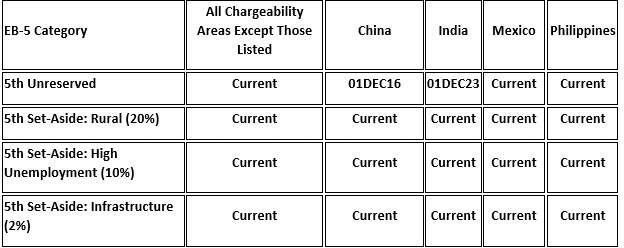
Source: U.S. Department of State, Visa Bulletin for October 2026.
The October bulletin therefore continues to show a significant difference between EB-5 Unreserved and the three Reserved EB-5 categories.
A New Fiscal Year: What Changed on October 1?
October 1 marks the beginning of Fiscal Year 2027 for the U.S. government.
This is particularly relevant for EB-5 because immigrant visa numbers are subject to annual numerical limits.
In June 2026, the Department of State announced that all available FY2026 EB-5 Unreserved immigrant visas for applicants chargeable to India had been issued as of June 5, 2026. The Department stated that embassies and consulates could not issue additional visas in those categories for the remainder of FY2026, with the annual limits resetting on October 1, 2026.
The start of FY2027 therefore provides a fresh annual allocation of immigrant visa numbers.
However, investors should not assume that the October dates will remain unchanged throughout the fiscal year.
Visa availability is continuously monitored, and future Visa Bulletins can reflect changes in demand and number usage.
The Good News: EB-5 Reserved Categories Remain Current
The most notable feature of the October 2026 bulletin is the continued Current status of all three Reserved EB-5 categories.
For October:
Rural EB-5
The Rural Area set-aside reserves 20% of annual EB-5 visas for qualifying investments in designated rural areas.
The category is listed as Current worldwide in October 2026.
For investors from countries with Unreserved EB-5 backlogs, the continued availability of the Rural category may be an important consideration when evaluating an EB-5 investment.
However, investors should not select a project solely because it qualifies as rural.
The underlying investment still requires careful review of the project's financial structure, developer, job creation plan, financing, project status, and exit strategy.
High-Unemployment Area EB-5
The High-Unemployment Area set-aside reserves 10% of annual EB-5 visas for qualifying investments in areas that meet the program's requirements.
The category is also Current worldwide for October 2026.
For investors comparing projects in different locations, understanding whether a project qualifies for this reserved allocation can therefore be an important part of reviewing its immigration structure.
Infrastructure EB-5
The Infrastructure category represents 2% of the annual EB-5 allocation.
It remains Current worldwide in October 2026.
Because infrastructure projects must meet specific statutory requirements, investors should verify the project's eligibility for this category rather than relying solely on marketing descriptions.
India: FY2027 Begins After the FY2026 Unreserved Limit Was Reached
India remains one of the most closely watched EB-5 markets.
In June 2026, the Department of State confirmed that the FY2026 allocation for EB-5 Unreserved applicants chargeable to India had been reached. Visa issuance in that category was therefore stopped for the remainder of FY2026.
With the beginning of FY2027 on October 1, the annual limits reset.
The October 2026 Visa Bulletin now lists an EB-5 Unreserved Final Action Date of December 1, 2023 for India.
This is an important change in context from the end of FY2026.
The new fiscal year allows visa issuance to resume subject to the applicable limits and dates, but it does not mean that Indian investors have unlimited visa availability.
Demand and number usage will continue to be monitored throughout FY2027.
For Indian investors, the distinction between Unreserved and Reserved EB-5 therefore remains particularly important.
China: Unreserved EB-5 Remains Backlogged
Chinese investors continue to face a substantially different situation.
For October 2026, the EB-5 Unreserved Final Action Date for China is December 1, 2016.
This means that investors chargeable to mainland China with priority dates later than the published cut-off are not currently eligible for final visa issuance in the Unreserved category.
At the same time, the three Reserved EB-5 categories , Rural, High-Unemployment, and Infrastructure,are all listed as Current.
This creates a significant distinction between the Unreserved and Reserved categories for Chinese investors.
The October Dates for Filing chart lists March 1, 2021 for Chinese Unreserved EB-5 applicants.
Investors should remember that Dates for Filing and Final Action Dates serve different purposes and should not be treated as interchangeable.
What Does October Mean for Reserved EB-5 Investors?
The October bulletin creates a clear picture:
Unreserved EB-5
China — December 1, 2016
India — December 1, 2023
Most other countries — Current
Reserved EB-5
Rural — Current worldwide
High-Unemployment — Current worldwide
Infrastructure — Current worldwide
For investors from countries experiencing Unreserved backlogs, this difference may make the EB-5 category associated with a project an important consideration.
However, Current does not mean guaranteed approval or immediate permanent residence.
Investors must still satisfy all applicable EB-5 requirements, and the project itself must meet the requirements of the relevant reserved category.
Does “Current” Mean an Investor Gets a Green Card Immediately?
Not necessarily.
The Department of State uses “C” to indicate that a category is Current, meaning immigrant visa numbers are authorized for qualified applicants without a published Final Action Date restriction.
But Current status does not guarantee:
Immediate I-526E approval
Immediate visa issuance
Immediate adjustment of status
A specific processing timeline
Green card approval
Return of invested capital
A particular investment outcome
Investors must still complete the required immigration process and satisfy all applicable eligibility requirements.
This distinction is particularly important when evaluating EB-5 projects marketed around their visa category.
What About the October Dates for Filing?
The October 2026 Dates for Filing chart provides another important set of EB-5 dates.
For EB-5 Unreserved:
Most countries: Current
China: March 1, 2021
India: May 1, 2024
Mexico: Current
Philippines: Current
For the Reserved categories:
Rural: Current worldwide
High-Unemployment: Current worldwide
Infrastructure: Current worldwide
The Department of State notes that applicants should consult USCIS regarding whether the Dates for Filing chart may be used for adjustment-of-status applications during the month.
Investors inside the United States should therefore verify the applicable USCIS guidance before filing Form I-485.
A Key Point for Investors Living in the UAE
For international investors, there is another important issue to understand:
Your country of residence is not necessarily your country of Visa Bulletin chargeability.
Many EB-5 investors live in Dubai or Abu Dhabi while being chargeable to another country.
For example, an investor born in India and living in the UAE will generally need to consider the India chargeability category rather than assuming that living in the UAE creates a separate Visa Bulletin category.
Country-of-chargeability rules can involve individual circumstances and exceptions, so investors should confirm their situation with qualified immigration counsel.
For UAE-based investors, this distinction can be particularly important when comparing EB-5 opportunities.
Why EB-5 Project Selection Matters More Than the Headline Investment Amount
The October Visa Bulletin highlights an important point for investors:
The EB-5 investment is not simply about the amount of capital required.
Investors should understand:
Which EB-5 category the project falls under
Whether it qualifies for a Reserved allocation
The project's location
The job-creation methodology
The project's capital structure
The developer's experience
The Regional Center structure
The project's expected timeline
The potential exit strategy
A project being classified as Rural, High-Unemployment, or Infrastructure does not by itself determine whether it is an appropriate investment.
The investment and immigration structures should both be reviewed carefully.
Arcasia Advisors Insight
The October 2026 Visa Bulletin reinforces a trend that EB-5 investors have been watching closely:
Visa availability is becoming an increasingly important part of EB-5 project evaluation.
For an investor from a country with significant Unreserved demand, the question is no longer simply:
“Can I qualify for EB-5?”
It may also be:
“Which EB-5 visa category applies to my investment, and what does the current Visa Bulletin mean for my case?”
The October bulletin shows this distinction clearly.
An Indian investor faces a December 1, 2023 Unreserved Final Action Date.
A Chinese investor faces a December 1, 2016 Unreserved Final Action Date.
Meanwhile, the Rural, High-Unemployment, and Infrastructure categories are all Current.
This does not eliminate the need for investment due diligence. Instead, it demonstrates why immigration planning and investment due diligence should be considered together.
What Should EB-5 Investors Do Now?
1. Understand Your Country of Chargeability
Determine which Visa Bulletin category applies to your individual circumstances.
2. Identify the EB-5 Category
Confirm whether the project is Unreserved, Rural, High-Unemployment, or Infrastructure.
3. Check Your Priority Date
Compare your priority date with the applicable Final Action Date.
4. Review the Dates for Filing
If you are eligible to adjust status in the United States, check the applicable USCIS guidance.
5. Conduct Project Due Diligence
Review the developer, Regional Center, project economics, capital structure, job creation methodology, and exit strategy.
6. Review Your Immigration Strategy
Qualified immigration counsel can assess how the Visa Bulletin and EB-5 category apply to your individual circumstances.
7. Continue Monitoring the Visa Bulletin
October is only the first month of FY2027. Future visa availability can change as demand develops.
Looking Ahead: Fiscal Year 2027
The October 2026 bulletin begins a new fiscal year, but it is only the beginning of the FY2027 visa allocation cycle.
The Department of State states that visa availability is continually monitored and that adjustments may be necessary to keep visa issuances within quarterly and annual limits.
For EB-5 investors, several developments will therefore be worth monitoring throughout FY2027:
Demand in the Unreserved category
Visa usage by country
Movement of China and India Final Action Dates
Demand for Reserved EB-5 categories
Future Visa Bulletin movements
Any potential retrogression
The October bulletin provides the current picture — but future bulletins will show how visa availability develops during the fiscal year.
October 2026 EB-5 Takeaway
The October 2026 Visa Bulletin begins Fiscal Year 2027 with a clear distinction between Reserved and Unreserved EB-5.
EB-5 Unreserved
Most countries: Current
China: December 1, 2016
India: December 1, 2023
Philippines: Current
EB-5 Reserved
Rural — 20%: Current worldwide
High-Unemployment — 10%: Current worldwide
Infrastructure — 2%: Current worldwide
For investors, particularly those based in the UAE and internationally chargeable to India or China, understanding these categories can be an important part of EB-5 planning.
The beginning of FY2027 also follows the exhaustion of India's FY2026 Unreserved allocation, making the October bulletin especially relevant for Indian investors.
At the same time, investors should remember that Visa Bulletin availability is only one part of an EB-5 investment decision.
Project fundamentals, job creation, capital structure, developer and Regional Center experience, immigration compliance, source of funds, and exit strategy should also be carefully reviewed.
Source: U.S. Department of State, Visa Bulletin for October 2026.
Disclaimer:
This article is provided for general informational purposes only and should not be considered legal, investment, tax, or immigration advice. Investors should consult qualified immigration attorneys, financial advisors, and tax professionals before making any investment or immigration decisions.
Source
U.S. Department of State — October 2026 Visa Bulletin