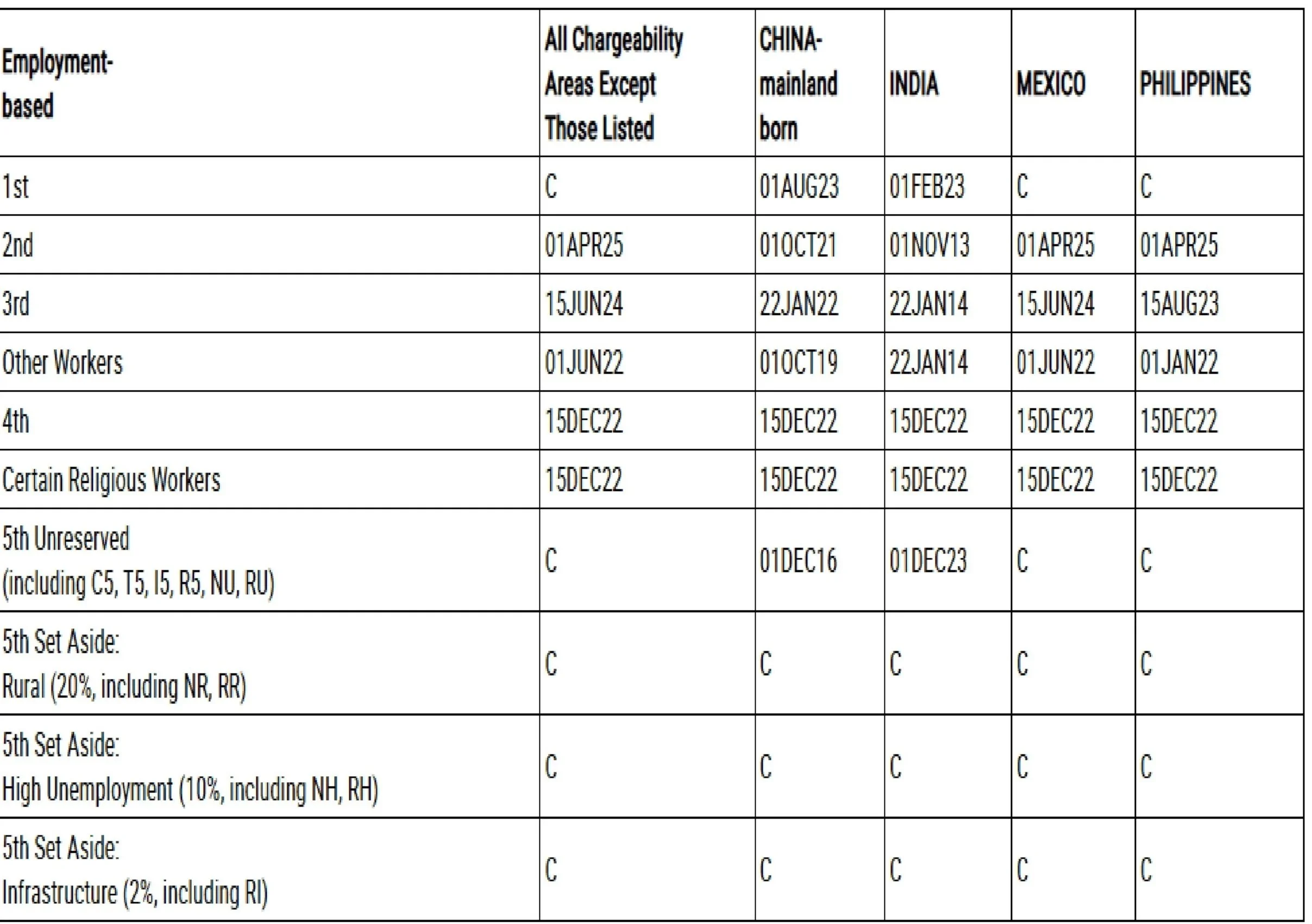
EB-5 Unreserved remains Current for most countries, while Rural, High-Unemployment Area, and Infrastructure categories continue to show Current status worldwide.
The U.S. Department of State has released the November 2026 Visa Bulletin, providing updated information on immigrant visa availability for investors pursuing U.S. permanent residency through the EB-5 Immigrant Investor Program.
For November, the EB-5 category continues to offer favorable visa availability for investors from many countries. The EB-5 Unreserved category remains Current for most countries, including the Philippines, while mainland China and India continue to have cutoff dates. Meanwhile, the three EB-5 set-aside categories—Rural, High-Unemployment Area, and Infrastructure—remain Current across all listed chargeability areas.
These distinctions are important for prospective investors evaluating their immigration options. Visa availability can influence an investor's potential timeline, although the Visa Bulletin alone cannot determine how quickly an individual case will be processed or when permanent residency may be granted.
For investors considering EB-5 from the UAE and other international markets, the November bulletin provides an opportunity to review current visa availability, understand the differences between investment categories, and assess the factors that may affect their immigration planning.
November 2026 EB-5 Visa Bulletin: Key Highlights
The November 2026 Visa Bulletin outlines the following developments for the EB-5 category:
EB-5 Unreserved: Remains Current for all chargeability areas except mainland China and India.
China: The Unreserved Final Action Date remains December 1, 2016.
India: The Unreserved Final Action Date remains December 1, 2023.
Rural investments: Remain Current across all listed chargeability areas.
High-Unemployment Area investments: Remain Current across all listed chargeability areas.
Infrastructure investments: Remain Current across all listed chargeability areas.
The bulletin also provides separate Dates for Filing, which are particularly relevant to investors and immigration professionals planning the next steps in the process.
It is important to understand that Current status does not guarantee immediate approval, visa issuance, or a specific green card timeline. Applicants must still satisfy the applicable EB-5 requirements and follow the procedures relevant to their circumstances.
EB-5 Final Action Dates for November 2026
Final Action Dates indicate when immigrant visa numbers are available for final adjudication, subject to the applicable requirements.
For an oversubscribed category, an applicant generally must have a priority date earlier than the published cut-off date for a visa number to be available under that category.
What Do These Dates Mean for Investors?
The November bulletin shows a clear distinction between the Unreserved category and the three reserved categories.
For investors chargeable to most countries, including the Philippines, the Unreserved category remains Current. This means there is no cutoff-date backlog shown for those chargeability areas in the November Final Action Dates chart.
Mainland China and India continue to have cutoff dates in the Unreserved category. Investors chargeable to these countries should compare their individual priority dates with the relevant published dates.
For the Rural, High-Unemployment Area, and Infrastructure categories, all listed chargeability areas remain Current.
This is an important distinction for investors evaluating qualifying projects within the EB-5 set-aside framework. However, the published dates should be considered alongside individual eligibility, petition status, and the applicable visa-processing route.
Final Action Dates vs. Dates for Filing
Understanding the difference between these two charts is essential.
Final Action Dates indicate when a visa number is available for final action, subject to the applicable requirements.
Dates for Filing indicate when eligible applicants may be able to submit documentation for the next stage of the immigrant visa process. For applicants processing through a U.S. consulate, the National Visa Center provides instructions when the case is ready for document submission.
For applicants already in the United States who are seeking adjustment of status, USCIS determines which chart applies to employment-based adjustment applications for a particular month. Applicants should confirm the applicable chart before filing Form I-485.
A priority date that qualifies under the Dates for Filing chart does not automatically mean that a visa number is available for final approval.
Investors should therefore review both charts and confirm which one applies to their individual circumstances.
EB-5 Unreserved: What Investors Should Know
The EB-5 Unreserved category covers qualifying investments that do not fall within one of the three designated set-aside categories.
For November 2026, the Unreserved Final Action Dates remain:
Most countries, including the Philippines: Current
Mainland China: December 1, 2016
India: December 1, 2023
The Dates for Filing chart shows Current status for most countries, with cutoff dates of March 1, 2021, for mainland China and May 1, 2024, for India.
Why Is Country of Chargeability Important?
Visa Bulletin categories are generally determined by the applicant's country of chargeability, which is ordinarily based on the applicant's country of birth rather than citizenship or current residence.
For example, an investor who is a Philippine citizen but was born in another country may need to determine whether a different chargeability rule applies.
Certain applicants may be eligible to use a spouse's country of chargeability under applicable cross-chargeability rules. This is a case-specific issue that should be reviewed with qualified immigration counsel.
For investors living in the UAE, the country where they currently reside does not, by itself, determine their Visa Bulletin chargeability.
Understanding this distinction can help investors interpret the correct cutoff dates and avoid relying on information that applies to a different country.
EB-5 Set-Aside Categories Remain Current
The November 2026 bulletin continues to show Current status for all three EB-5 set-aside categories.
These categories were established under the EB-5 Reform and Integrity Act of 2022 to reserve portions of the annual EB-5 visa allocation for qualifying investments.
1. Rural Investments
The Rural category reserves 20% of the annual EB-5 visa allocation for qualifying rural investments.
For November 2026, the Rural category is Current for all listed chargeability areas under both the Final Action Dates and Dates for Filing charts.
For eligible investors, this indicates that the November bulletin does not show a cutoff-date backlog in this category.
However, visa availability is only one part of the investment decision. Investors must still assess whether a project qualifies for the Rural category and whether the investment satisfies the applicable EB-5 requirements.
2. High-Unemployment Area Investments
The High-Unemployment Area category reserves 10% of the annual EB-5 visa allocation for qualifying investments in designated high-unemployment areas.
The category remains Current worldwide in the November bulletin.
Investors considering this option should confirm the project's eligibility for the relevant set-aside category and review the supporting project documentation.
A project's marketing materials should not be the sole basis for determining whether an investment qualifies.
3. Infrastructure Investments
The Infrastructure category reserves 2% of the annual EB-5 visa allocation for qualifying infrastructure projects.
This category also remains Current across all listed chargeability areas in November 2026.
Infrastructure investments are subject to specific eligibility requirements. Investors should review the project's structure and applicable documentation to understand whether it qualifies for this category.
What Does Current Status Mean for Set-Aside Investors?
The continued Current status of all three set-aside categories is an important point for investors comparing EB-5 options.
It indicates that the November bulletin does not establish a cutoff date for these categories. Nevertheless, Current status should not be interpreted as a guarantee that a particular petition will be approved quickly or that a visa will be issued immediately.
Investors should still consider:
Whether the project qualifies for the selected set-aside category
Whether the investor meets the applicable eligibility requirements
Whether the petition is complete and properly documented
Whether a visa number is available at the relevant stage
Whether the investor is processing through consular processing or adjustment of status
The project's financial structure, job creation plan, and investment risks
Visa availability is an important consideration, but it should form part of a broader evaluation rather than serve as the sole basis for selecting an EB-5 project.
Does the November Visa Bulletin Mean Investors Should File Immediately?
The November bulletin may prompt investors to reassess their plans, particularly if they are considering a qualifying set-aside investment or are chargeable to a country where the Unreserved category remains Current.
However, a Current category does not automatically mean that every prospective investor should file immediately.
Before proceeding, investors should consider the following:
1. Confirm the investment category.
Determine whether the proposed investment falls under the Unreserved, Rural, High-Unemployment Area, or Infrastructure category.
2. Review project eligibility.
Confirm the project's eligibility and review the relevant supporting documentation rather than relying exclusively on promotional claims.
3. Prepare source-of-funds documentation.
Investors must be prepared to document the lawful source and path of their investment capital in accordance with applicable requirements.
4. Understand the investment risks.
Evaluate the project's capital structure, developer experience, job creation strategy, financial assumptions, and exit strategy.
5. Confirm the applicable Visa Bulletin chart.
Investors pursuing adjustment of status should check which chart USCIS has designated for the relevant month.
6. Obtain professional advice.
Qualified U.S. immigration counsel can help assess eligibility, filing readiness, and the appropriate next steps.
A well-informed decision should take account of both immigration considerations and the financial risks of the investment.
Can Visa Bulletin Dates Move Backward?
Yes. Visa Bulletin dates can advance, remain unchanged, retrogress, or become unavailable, depending on visa demand and the applicable numerical limits.
A category being Current in November does not guarantee that it will remain Current in subsequent months.
The Department of State manages immigrant visa numbers within statutory limits. If demand exceeds the available allocation, cutoff dates may be introduced or moved backward.
For EB-5 investors, this means that the November bulletin should be treated as a snapshot of visa availability for that month, not a prediction of future movement.
Investors should monitor future bulletins and seek individualized guidance when making decisions that depend on visa availability.
Frequently Asked Questions
1. Is the EB-5 Unreserved category Current in November 2026?
The Unreserved category is Current for all chargeability areas except mainland China and India. The Final Action Date is December 1, 2016, for mainland China and December 1, 2023, for India.
2. Are EB-5 Rural investments Current in November 2026?
Yes. The Rural category is Current across all listed chargeability areas under both the Final Action Dates and Dates for Filing charts.
3. Are High-Unemployment Area investments Current?
Yes. The High-Unemployment Area set-aside category remains Current across all listed chargeability areas in November 2026.
4. Are Infrastructure investments Current?
Yes. The Infrastructure set-aside category remains Current across all listed chargeability areas in the November bulletin.
5. What is the difference between Final Action Dates and Dates for Filing?
Final Action Dates indicate when visa numbers are available for final action, subject to applicable requirements. Dates for Filing indicate when eligible applicants may be able to submit documentation for the next stage of the process. Adjustment-of-status applicants must also follow USCIS's chart designation for the relevant month.
6. Does Current status guarantee immediate green card approval?
No. Current status means the bulletin does not impose a cutoff date for the relevant category and chargeability area. Petition adjudication, eligibility requirements, documentation, visa processing, and other factors can still affect the timeline.
7. Does living in Dubai determine my country of chargeability?
No. Chargeability is generally based on country of birth, subject to applicable exceptions. Living in the UAE does not automatically make an investor chargeable to the UAE.
8. Can Visa Bulletin dates change in future months?
Yes. Dates may advance, remain unchanged, retrogress, or become unavailable as visa demand and numerical limits change.
9. Should I choose an EB-5 project based only on visa availability?
No. Visa availability is one factor in the decision. Investors should also review project eligibility, financial structure, developer experience, job creation, source-of-funds requirements, and investment risks.
10. Where can investors find the official November 2026 Visa Bulletin?
The official bulletin is published by the U.S. Department of State. Investors should consult the original bulletin and seek qualified immigration advice when assessing their individual circumstances.
Arcasia Advisors Perspective
The November 2026 Visa Bulletin highlights the importance of understanding the distinction between EB-5 Unreserved investments and the three reserved categories.
While the Unreserved category remains Current for many countries, mainland China and India continue to have cutoff dates. The Rural, High-Unemployment Area, and Infrastructure categories remain Current across all listed chargeability areas.
For investors considering U.S. investment immigration, these differences may be relevant when comparing eligible investment options and evaluating potential immigration timelines. However, visa availability should never be the only factor in an investment decision.
At Arcasia Advisors, we encourage investors to approach EB-5 with a comprehensive perspective that considers immigration requirements, project due diligence, financial structure, job creation, source-of-funds documentation, and investment risk.
For investors based in the UAE and other international markets, understanding the Visa Bulletin is an important part of planning. The next step is to assess how the published dates apply to the investor's country of chargeability, proposed investment category, and individual circumstances.
Disclaimer:
This article is for general informational purposes only and does not constitute legal, tax, financial, or investment advice. Visa Bulletin dates and immigration requirements may change. Current status does not guarantee petition approval, immediate visa issuance, or a specific immigration timeline. Investors should consult the official U.S. Department of State Visa Bulletin, verify the applicable USCIS filing chart, and seek advice from qualified U.S. immigration counsel before making decisions
Source : U.S. Department of State — November 2026 Visa Bulletin