Beyond the $800,000: The Hidden Costs of an EB-5 Investment

When investors hear about the EB-5 Immigrant Investor Program, one of the first numbers they typically encounter is $800,000. However, the minimum qualifying investment is not necessarily the total amount an investor will spend throughout the EB-5 process.
For many prospective investors, understanding the EB-5 program begins with understanding the required investment amount. Under the current framework, qualifying investments generally require $800,000 in a Targeted Employment Area (TEA) or qualifying infrastructure project, while investments outside these categories generally require $1.05 million.
However, the investment capital represents only one component of the overall financial commitment.
An investor may also need to account for immigration attorney fees, government filing fees, regional center or administrative charges, due diligence costs, banking expenses, tax and accounting advice, and other professional services.
For this reason, prospective investors should consider the total cost of their EB-5 strategy, rather than focusing exclusively on the headline investment amount.
The $800,000 EB-5 Investment
Under the current EB-5 framework established by the EB-5 Reform and Integrity Act of 2022, the minimum investment amount is generally:
$800,000 for qualifying investments in a Targeted Employment Area or qualifying infrastructure project; or
$1.05 million for investments that do not qualify for the reduced investment threshold.
The required investment must be made into a qualifying new commercial enterprise and must satisfy the applicable EB-5 requirements, including the requirement to create at least 10 qualifying full-time jobs for U.S. workers.
The investment must also meet other program requirements, including the requirement that the capital is placed at risk for the purpose of generating a return.
It is important to understand that the $800,000 is investment capital, not necessarily the complete cost of pursuing an EB-5 immigration strategy.
An investor may therefore need to have additional funds available beyond the investment amount.
Why the $800,000 Figure Can Be Misleading
The $800,000 figure is important because it represents the minimum qualifying investment for certain EB-5 projects. However, it does not automatically include every expense associated with the immigration process.
Think of the EB-5 financial commitment as having several separate components:
EB-5 investment capital
The funds invested into the qualifying project.
Government filing fees
Fees paid to U.S. government agencies for immigration filings and related applications.
Legal fees
Professional fees associated with immigration counsel and, where appropriate, other legal services.
Project or administrative fees
Depending on the structure of an EB-5 offering, investors may encounter regional center, administrative, syndication, management, or related fees.
Due diligence and professional services
Investors may choose to retain independent financial, tax, accounting, business, or legal professionals.
Banking and currency-transfer costs
International investors may incur costs when transferring funds from their home country to the United States.
Tax-related expenses
Investors may need professional advice regarding U.S. tax obligations, reporting requirements, and the tax implications of their investment and immigration status.
These expenses can vary considerably from one investor to another.
1. Immigration Attorney Fees
One of the most significant additional expenses can be the cost of immigration legal representation.
EB-5 involves extensive documentation and requires investors to demonstrate that they satisfy the applicable immigration and investment requirements.
Depending on the investor's circumstances, legal services may cover matters such as:
Preparation and filing of the EB-5 petition
Review of investor documentation
Source-of-funds documentation
Lawful-source-of-funds analysis
Preparation of supporting evidence
Responses to requests for evidence, when necessary
Adjustment of status or consular processing
Follow-up immigration filings
Permanent residence-related matters
Attorney fees vary depending on the law firm, the complexity of the investor's financial history, the services included, and the stage of the immigration process.
Investors should therefore ask prospective counsel to provide a clear explanation of what is included in the legal fee and what services may result in additional charges.
For example, an initial legal fee may cover preparation of the I-526E petition but may not necessarily include every subsequent immigration filing or response to an unexpected government request.
Understanding the fee structure in advance can help investors plan their overall budget more accurately.
2. USCIS and Government Filing Fees
Government filing fees represent another important part of the overall EB-5 budget.
USCIS charges fees for various immigration applications and petitions. Depending on the investor's circumstances and immigration pathway, multiple filings may be required throughout the process.
These can include fees associated with:
The EB-5 petition
Adjustment of status, when applicable
Employment authorization, when applicable
Travel documentation, when applicable
Other immigration-related applications
Government fees are separate from the $800,000 investment.
They can also change over time, which means investors should verify the applicable fee schedule before submitting a filing.
Because filing fees may change, investors should avoid relying on an old fee estimate when calculating the total cost of an EB-5 process.
3. Regional Center and Administrative Fees
Many EB-5 investors participate through a Regional Center-sponsored project rather than making a direct investment into and managing their own qualifying business.
Depending on the project structure, investors may encounter additional project-related fees.
These can include:
Administrative fees
Regional Center-related fees
Fund administration expenses
Syndication or structuring costs
Management-related expenses
Other project-specific charges
These fees are generally separate from the required EB-5 investment capital.
For example, a project may require an investor to contribute the qualifying investment amount while also paying a separate administrative fee.
The amount and structure of these fees vary significantly between projects.
This is one reason investors should carefully review the project's offering documents and understand exactly where their money is going before making a commitment.
A lower fee does not necessarily mean a better investment, just as a higher fee does not automatically indicate a better project.
The fee should be evaluated in the context of the overall investment structure, project economics, risk profile, developer experience, job-creation strategy, and other relevant factors.
4. Due Diligence Expenses
EB-5 investors are making a substantial financial commitment. As a result, independent due diligence can be an important part of the decision-making process.
Some investors choose to hire professionals to independently evaluate different aspects of a proposed investment.
Depending on the circumstances, this may include:
Financial Due Diligence
A financial professional may review the project's financial structure, projections, capital stack, sources and uses of funds, and other relevant financial information.
Legal Due Diligence
Independent legal counsel may review the offering documents, subscription agreement, operating agreement, private placement memorandum, and other legal materials.
Tax Due Diligence
A tax professional may help an investor understand potential U.S. tax consequences and reporting obligations.
Business or Commercial Due Diligence
Investors may also seek independent analysis of the underlying business, market, developer, or project economics.
Not every investor will require all of these services. However, investors should recognize that independent due diligence can represent an additional expense beyond the investment itself.
5. Banking and Currency-Transfer Costs
For international investors, transferring a large amount of capital internationally can create additional expenses.
An investor may encounter:
International wire fees
Correspondent bank fees
Receiving bank charges
Foreign-exchange spreads
Currency-conversion fees
Transfer limits
Additional bank compliance requirements
For an investor transferring funds from another currency into U.S. dollars, the exchange rate itself can have a meaningful financial impact.
For example, an investor who needs to transfer the equivalent of $800,000 may ultimately need to send more in their home currency depending on the exchange rate and transaction costs.
Investors should therefore speak with their financial institution or qualified foreign-exchange provider before initiating a major transfer.
They should also maintain documentation showing the movement of funds, particularly because EB-5 cases require detailed evidence concerning the lawful source and path of investment capital.
6. Source-of-Funds Documentation
One of the most important financial aspects of an EB-5 case is demonstrating that the investment capital was obtained lawfully.
This can become particularly complex when funds come from multiple sources.
An investor may need to document money derived from:
Salary or employment income
Business income
Sale of real estate
Sale of a business
Dividends
Investments
Inheritance
Gifts
Loans
Previous asset sales
Other lawful sources
The documentation required will depend on the investor's individual circumstances.
For some investors, gathering and organizing these records can be straightforward.
For others, particularly those with multiple businesses, international assets, historical transactions, or complex financial structures, the process can be considerably more involved.
In some cases, investors may choose to engage tax professionals, accountants, financial advisors, or other specialists to help organize the relevant financial documentation.
These professional services may create additional expenses.
7. Tax and Accounting Advice
EB-5 is an immigration investment program, but the financial and tax implications should not be overlooked.
An investor's tax situation can depend on numerous factors, including:
Current country of residence
U.S. immigration status
Tax residency
Income sources
Investment structure
Ownership of foreign assets
Business interests
Timing of relocation to the United States
For investors planning to eventually relocate to the United States, understanding potential U.S. tax obligations before making major financial decisions can be valuable.
A qualified tax professional can help investors evaluate their individual circumstances.
Tax advice is separate from immigration advice, and investors should not assume that an immigration attorney, investment professional, or project representative is providing comprehensive tax advice.
In many cases, consulting the appropriate tax professional before making the investment may be more useful than waiting until after the transaction has already taken place.
8. Costs Related to Dependents
The EB-5 program may allow qualifying investors to include certain eligible family members in the immigration process.
However, family members can also affect the overall financial planning required for relocation.
An investor with a spouse and children may need to consider additional expenses associated with:
Immigration filings
Medical examinations
Document preparation
Translation
Travel
Relocation
Housing
Education
Health insurance
Establishing a new household in the United States
These expenses are not part of the EB-5 investment requirement itself.
However, they can represent a substantial part of the family's overall relocation budget.
For this reason, investors should consider both the immigration budget and the post-immigration financial plan.
9. Medical Examination and Document Costs
Depending on the immigration stage and the applicant's circumstances, medical examinations and supporting documentation may also create additional expenses.
Applicants may need to obtain:
Medical examinations
Vaccination records
Civil documents
Birth certificates
Marriage certificates
Police certificates, where applicable
Certified translations
Government-issued records
The cost of obtaining these documents varies by country.
Translation and certification costs can also increase when an applicant has extensive documentation.
For investors with complex family or international histories, the administrative costs can be higher than initially expected.
10. Travel and Relocation Expenses
The EB-5 investment itself does not cover the cost of moving to the United States.
Depending on the investor's circumstances, relocation expenses may include:
Flights
Temporary accommodation
Permanent housing
Transportation
Household goods
School-related expenses
Health insurance
Initial living expenses
Vehicle purchase or transportation costs
Professional relocation services
These costs can be especially important for investors who plan to relocate with their entire family.
A family moving to the United States should generally maintain sufficient liquidity for the transition rather than committing every available dollar to the EB-5 investment.
Investment Capital vs. Fees: Why the Difference Matters
One of the most important concepts for prospective EB-5 investors to understand is the difference between investment capital and fees.
Investment Capital
The EB-5 investment is capital placed into a qualifying investment structure and must satisfy the program's applicable investment requirements.
The investment is subject to the EB-5 program's rules, including the requirement that the capital be placed at risk.
Fees and Expenses
Fees are payments for services, administration, government filings, professional advice, or other costs associated with the investment and immigration process.
These amounts should not automatically be considered part of the qualifying EB-5 investment.
For example, if an investor contributes $800,000 to a qualifying EB-5 project and separately pays an administrative fee and legal fees, the total amount the investor spends may be substantially greater than $800,000.
This distinction is important when calculating the actual financial commitment.
Why Investors Should Avoid Using Every Available Dollar
An investor may technically have enough funds to meet the EB-5 investment requirement but still be financially unprepared for the overall process.
For example, an investor who has exactly $800,000 available may face challenges if additional funds are needed for:
Legal fees
Government filing fees
Project-related fees
Tax advice
Currency conversion
Family relocation
Emergency expenses
This is why liquidity planning is an important part of EB-5 preparation.
Investors should consider maintaining a reasonable financial reserve outside of the EB-5 investment, particularly if they are also planning to relocate to the United States.
The exact amount of additional liquidity required will depend on the investor's personal circumstances, family size, existing assets, income, and relocation plans.
A Simple EB-5 Budget Framework
Before committing to an EB-5 project, investors can organize their expected expenses into several categories.
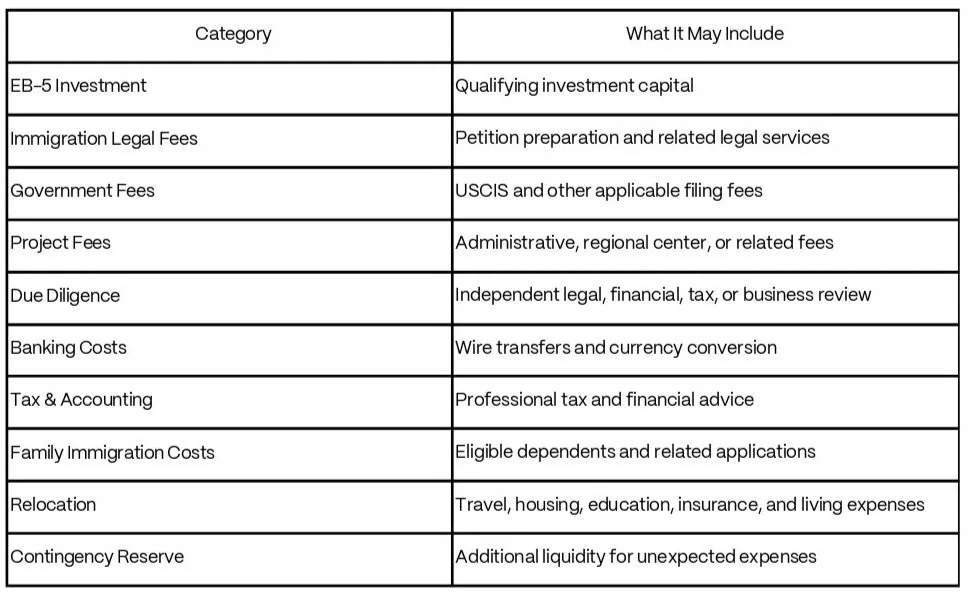
This approach provides a more realistic picture of the financial commitment.
What Investors Should Ask Before Committing
Before making an EB-5 investment, prospective investors should consider asking detailed questions about both the investment and the associated costs.
About the Investment
What is the required investment amount?
Does the project qualify for the $800,000 threshold?
What is the project's job-creation strategy?
How is the investment structured?
What are the major risks?
What are the expected repayment terms?
What is the anticipated investment timeline?
2. About Project Fees
Is there a separate administrative fee?
Are there any additional project-related charges?
Are all fees disclosed in the offering documents?
Are there ongoing management or administrative expenses?
Are any fees refundable?
3. About Legal Services
What does the legal fee cover?
Are government responses included?
Are additional immigration filings included?
Are family members covered?
What circumstances could result in additional legal fee?
4. About Financial Planning
How will the investment funds be transferred?
What currency conversion costs may apply?
What documentation will be required to demonstrate the lawful source and path of funds?
Should an independent tax professional review the transaction?
How much liquidity should be maintained outside the EB-5 investment?
These questions can help investors identify expenses before they become unexpected costs.
The Importance of Reviewing the Full Investment Structure
The cost of an EB-5 investment should not be evaluated based solely on the headline investment amount.
Two projects may both require an $800,000 investment but have very different structures, fees, business models, financing arrangements, job-creation strategies, and risk profiles.
Investors should therefore look beyond the minimum investment threshold.
A comprehensive review may include examining:
The project's business plan
Capital structure
Sources and uses of funds
Developer background
Regional Center information
Job-creation methodology
Project financing
Loan structure
Exit strategy
Investor repayment provisions
Offering documents
Administrative fees
Potential conflicts of interest
Relevant financial and legal risks
The goal is not simply to find the lowest-cost EB-5 option.
The goal is to understand the complete investment and immigration strategy and determine whether it aligns with the investor's objectives and circumstances.
The $800,000 Should Be the Starting Point,Not the Entire Budget
For many investors, the most useful way to think about EB-5 is to separate the process into two financial questions:
How much capital must I invest to qualify?
and
How much money should I have available to complete the process and support my family?
These are not necessarily the same number.
The first question concerns the EB-5 investment requirement.
The second concerns overall financial preparedness.
An investor may satisfy the minimum investment requirement while still needing additional funds for legal services, government fees, due diligence, taxes, banking expenses, and relocation.
Planning for these costs in advance can help reduce financial stress and allow investors to approach the EB-5 process with greater confidence.
Final Thoughts
The headline $800,000 EB-5 investment requirement is an important figure, but it should not be treated as the complete cost of an EB-5 strategy.
For prospective investors, the more useful approach is to develop a comprehensive financial plan that considers:
The qualifying EB-5 investment
Government filing fees
Immigration attorney fees
Regional Center or project-related fees
Independent due diligence
Banking and currency-transfer expenses
Tax and accounting advice
Family-related immigration costs
Relocation expenses
An appropriate liquidity reserves
The exact amount required beyond the investment will vary from one investor to another.
Ultimately, successful EB-5 planning is about more than meeting the minimum investment threshold. It is about understanding the full financial picture, evaluating the investment carefully, and ensuring that sufficient resources remain available throughout the immigration and relocation process.
The Bottom Line
The right question is not simply:
“Can I invest $800,000?”
A better question is:
“Have I planned for the complete financial commitment of my EB-5 strategy?”
Understanding the potential costs before committing capital can help investors avoid unexpected financial pressure and make more informed decisions about their immigration and investment objectives.
Arcasia Advisors helps investors navigate the broader EB-5 investment landscape with a focus on clarity, preparation, and informed decision-making.
If you are considering EB-5 and would like to understand the investment structure, associated costs, and factors to evaluate before making a commitment, professional guidance can help you assess your options based on your individual circumstances.
Disclaimer
This article is for educational purposes only and does not constitute legal or financial advice. EB-5 investors should consult licensed immigration attorneys and qualified financial advisors before making any decisions.